Hope Beyond Hurt
Trauma Informed Coalition of the Laurel Highlands
Supporting Healing, Preventing Future Trauma
"Healing doesn't mean the damage never existed. It means the damage no longer controls our lives." — Akshay Dubey
"Healing doesn't mean the damage never existed. It means the damage no longer controls our lives." — Akshay Dubey
"Healing doesn't mean the damage never existed. It means the damage no longer controls our lives." — Akshay Dubey
Related Links
-
Quick Resources
-
Trauma-Informed Quotes
-
Looking for a Counselor or Therapist?
-
Statistics
-
PA Statistics
-
Nation-Wide Statistics
Take a Minute with Me….
Box Breathing to Calm Your Body and Mind
Use the power of your breath to slow everything down.
Imagine you are drawing a box with your fingers, each side is 4 seconds long.
Inhale for 4 seconds, hold for 4 seconds, exhale for 4 seconds, and hold again for 4 seconds.
Repeat for a few rounds.
5-4-3-2-1 Grounding to Bring You Back to Now
A simple way to reconnect with the present using your senses.
5 things you can see,
4 things you can touch,
3 things you can hear,
2 things you can smell,
and 1 thing you can taste.
You are here. You are safe.
Body Scan to Reconnect and Release Tension
Gently bring your attention to different parts of your body, from head to toe.
Notice any tension, and with each breath, imagine that space softening a little.
Cold Water Reset to Interrupt Overwhelm
When emotions feel too big, a cold sensation can help reset your nervous system.
Splash cold water on your face or hold something cold and focus on how it feels.
Name What You’re Feeling Without Judgment
Take a moment to notice and name what you’re feeling right now.
You don’t have to fix it—just giving it a name can help it feel less overwhelming.
Box Breathing toLoving-Kindness to Be Gentle With Yourself Calm Your Body and Mind
Offer yourself the same kindness you would give a friend.
Repeat phrases like, “May I be safe. May I be calm. May I be kind to myself.”
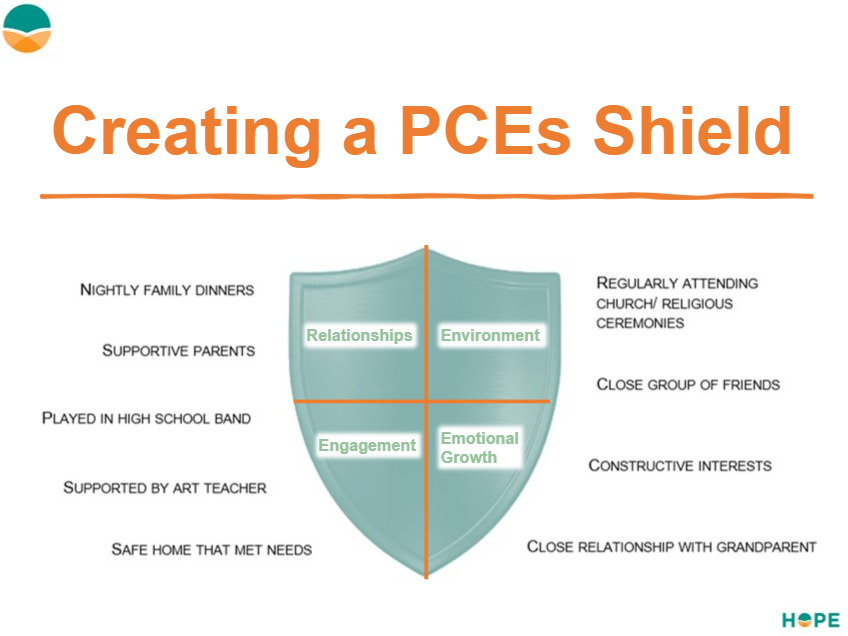
A PCEs Shield
The more PCEs the bigger the shield
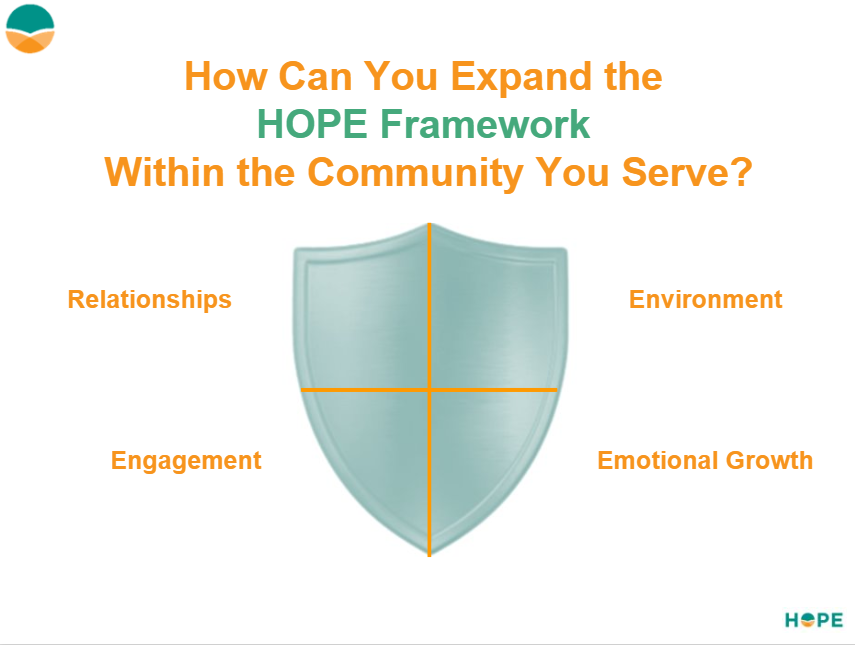
Creating a Community PCEs Shield
How does the community you serve define each building block?
▫ Who/What is included?
▫ What resources can promote it?
▫ How can you promote access to it?
▫ Who might have difficulty accessing it?
▫ What barriers exist to accessing it?
▫ What can be done to remove those barriers?
▫ Is there an action you can take to incorporate HOPE in your community within this building block?